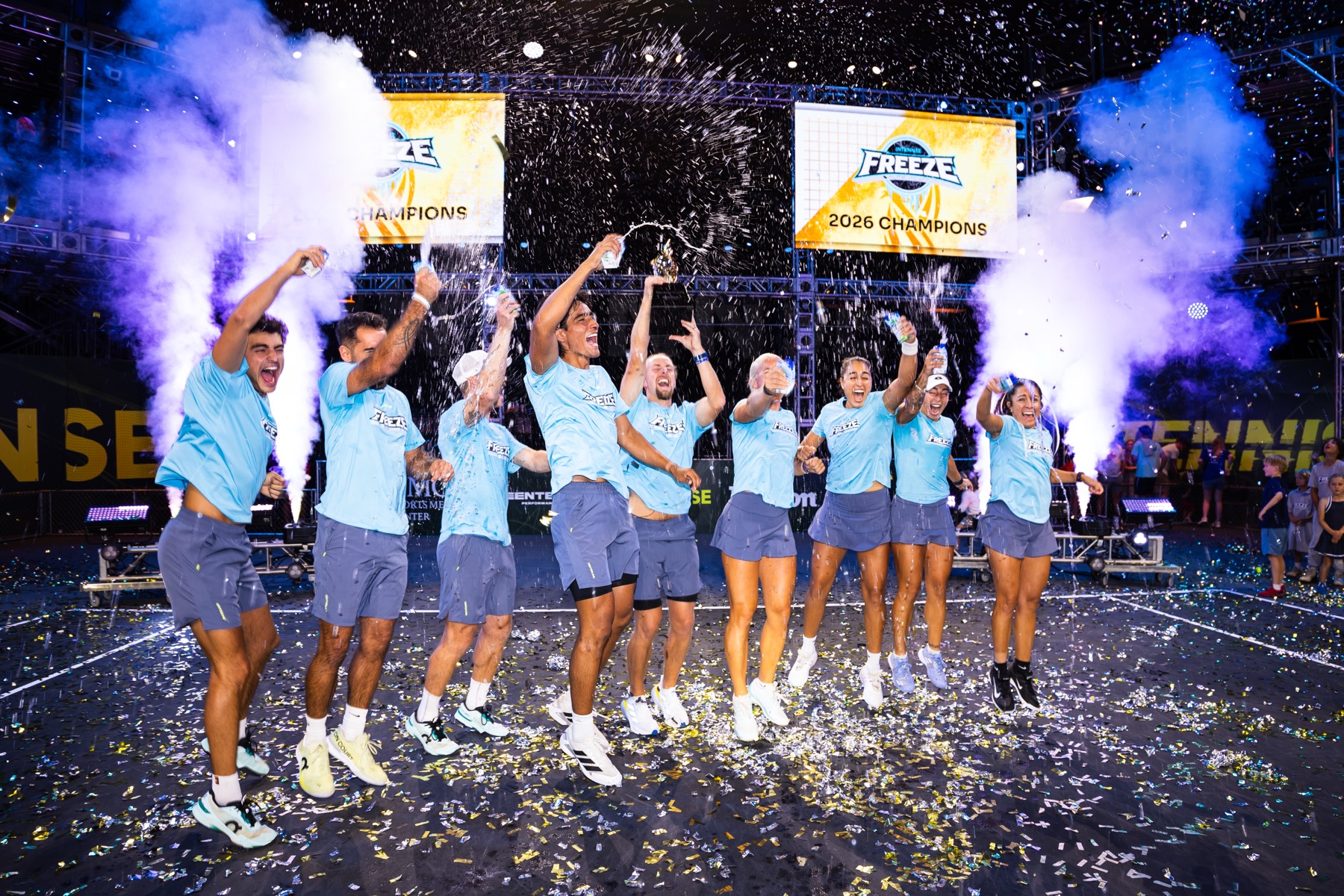
From Shep Rose · Team Outriders · Charleston · September 2026
“Drilled in the head by a ball machine.”
That is how Shep Rose describes the start of his tennis life — at tryouts, on Hilton Head, where his mother played several times a week and the Family Circle Cup came to town. He owns a piece of a professional tennis team now, and he lives here — in town, and out on the islands. He would like the team to play in Charleston too.
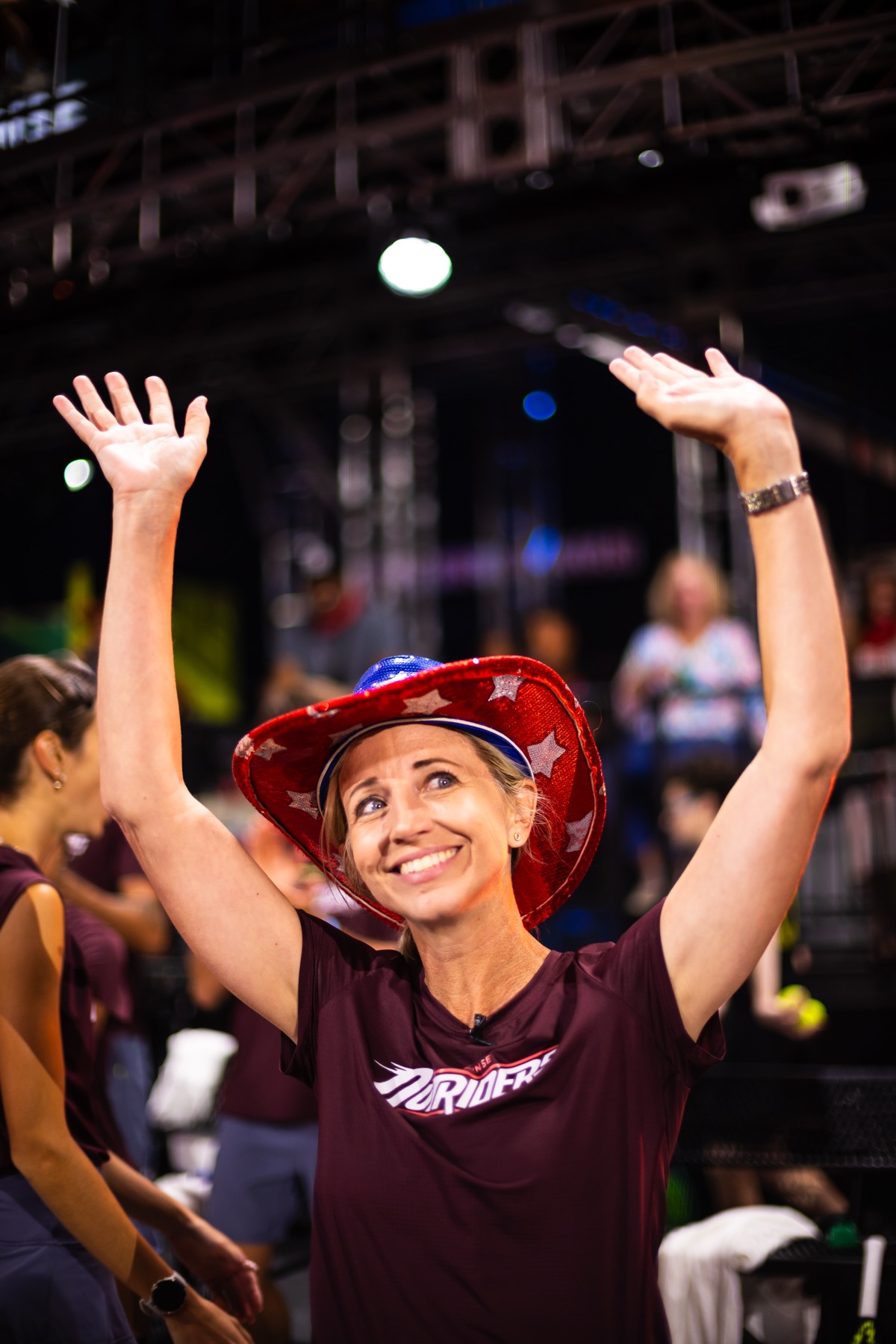
Shep Rose · Pulse Partner, the Outriders
In the stands, Atlanta · Season 2
A gender-balanced Professional Team Tennis League
Eight playing weeks in the middle of the summer. Switch the view to see the same season against the American sports year, or against the college calendar our players come from.
Where our players have been on the tour, and where they sit on the rating that covers everyone. The orange rule is where tennis starts paying for itself.
UTR: our players against the tour’s
Down to the wire; Sudden Death
Two Arcs that finished a point apart. Each clip picks up in the closing minutes, with the full Arc a click away.
Sudden death, level at 142
The final three minutes of Freeze v Rise, 20 June. The clock runs out with the teams tied, and the next point decides it: 143–142.
Match Center ↗One point, one minute left
The final minute of Outriders v Inferno, 25 June. It finishes 150–149, with the winner’s cheque on court.
Match Center ↗Two points that flipped the score
One from the net, one from the low camera. Each is about twenty seconds, and each one changed the scoreboard.
Low angle, the final Bolt
The last play of the Bolt from the low camera: a two-pointer that takes the Sting from 86–87 to 88–87. 22 seconds.
Match Center ↗Mixed doubles, last seconds
Dalayna Hewitt’s two-pointer in the closing seconds against Rise, 15 July — 156 to 158, level. 18 seconds.
Match Center ↗■ What this is
A professional tennis team, looking for a city. Shep thinks it’s this one.
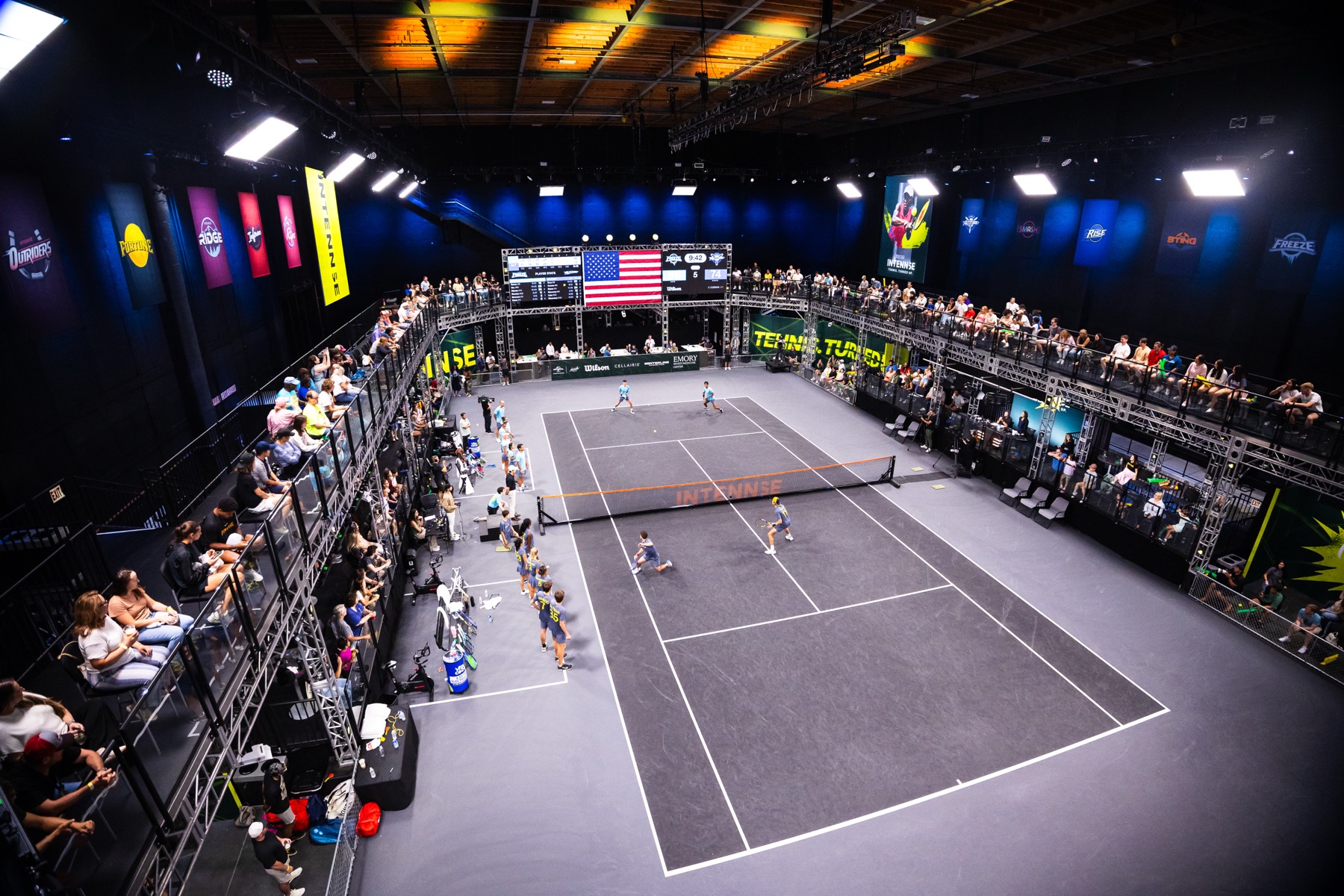
INTENNSE is a professional co-ed league: three women and three men on every team, one shared score, about an hour and forty minutes a match. Shep Rose came in as the Outriders’ Pulse Partner in March. In 2028 every team in the league moves to a home market of its own. He has a view about which market this one belongs in, and this page is him making the case to people who could actually do something about it.
“When Jeff first approached me, I thought he wanted me to play, and I was like, ‘Oh man, this is gonna be embarrassing, but I’ll give it a try.’”
Shep Rose · March 2026
He was told, in his own retelling: “No, you moron, it’s not you. Nobody wants to watch you.”
■ The name
Outriders. Outriggers. It is one letter and a boat.
The team is called the Outriders. In a harbour city, an outrigger is the arm that keeps a boat upright when the wind gets serious — and it is close enough to the existing name that the crest barely has to change. Consider it a starting point rather than a decision: a new owner names the team, and Charleston has a deep bench of better ideas than ours — the harbour, the pilots, Race Week, the schooner fleet.
What a rebrand actually involves
Every team in the league was named centrally, before any of them had a home market. The charter that puts a team in a city carries the right to rename and rebrand it for that city. Nothing about the Outriders’ identity is fixed, and nothing about it is Charleston’s yet.
■ The city
Charleston already fills a tennis stadium. For nine days a year.
The Credit One Charleston Open is the oldest professional all-women’s tournament in America, founded in 1973, and the only stop on the WTA Tour played on green clay. In 2026 it drew more than ninety thousand people across nine days, into an eleven-thousand-seat stadium built for tennis. It has been named the WTA 500 Tournament of the Year four years running. Then the clay goes quiet until next spring.
Ours is a summer season. Theirs is a spring fortnight. Nobody has to choose.
What the city supports already
The Charleston Battery, founded in 1993, are the oldest continuously operating professional soccer club in the United States and drew an average of 3,908 last season. The RiverDogs pulled 264,227 through a 5,500-seat park in 2025 — the highest attendance in all of Single-A baseball, by more than twenty thousand. This is a market of roughly 880,000 people that turns out for teams it can claim, and it has never had a major-league one of any kind.
Charleston is the 85th television market in the country and climbing, with about 400,000 households.
■ The team on offer
The Outriders lost the championship match by seven points.
Season 2 closed on 1 August with Freeze beating the Outriders 137–130 in front of a full house. Sofia Cabezas finished fifth in the league’s MVP race. And the executive director of USTA Atlanta spent the season coaching eight of these athletes, then wrote about it on her own feed, unprompted and unpaid.
“Innovative, fast-paced, co-ed team format challenged our players in new ways while creating an electric atmosphere that brought a fresh energy to the game.”
Amy Bartlett O’Connell · Executive Director, USTA Atlanta · 31 July 2026
One of the four clips at the top of this page is an Outriders match that finished 150–149. It is decided on the last point of the night.
■ Why he thinks it fits
“Faster paced, less formal, and therefore more accessible.”
That is Shep on the format, in March. He grew up on Hilton Head watching Evert, Graf and Navratilova at the Family Circle Cup before it moved up the coast to Daniel Island, and he has made Charleston home since. He has said he wants the Outriders to be “colorful, maybe a little irreverent, and very good, and wins all the championships.” Charleston is a city that has never once been accused of being formal about its enjoyment.
“I’m from Hilton Head Island. Tennis was a giant there. It still is.”
Shep Rose · March 2026
■ What Season 2 did in Atlanta









A season that already sells.
Ten teams, eight weeks, fifty-one matches. Season 2 closed on 1 August with Freeze beating Outriders 137–130 in front of a full house.
The local business
By midseason, attendance was more than four times the year before and had already passed the whole of 2025. Thirteen sponsors signed, twelve of them through relationships already in the city, with Atlanta-based Cellairis as Founding Partner. The average ticket sold for $52, and team merchandise outsold league merchandise.
Eleven community events drew 770 people off the couch and onto a court. Those are the numbers a local owner inherits and builds on.
The Rules of INTENNSE, explained · 2:04
Nearly 8,000 fans through a 500-seat arena.
Average across forty airings on Peachtree; the best single Arc drew 116,000.
Record live concurrents across the final series.
Two broadcast, two RSNs, seven FAST, three streaming — 60% of watch time on TV.
■ What an owner holds
A ten-year charter for the Charleston territory.
Owners hold an exclusive Team Charter: MLS-style, geographically bound economic rights, not a traditional franchise. Ten years, renewing in five-year terms.
The league keeps
- Game
- Format, rules, schedule, officiating
- Brand
- League marks and national sponsorship
- Rights
- Media and data rights
The owner holds
- Team
- Operations and team marks in the territory
- Revenue
- Local sponsorship, ticketing, hospitality, activations
- Share
- Team merchandise, and a share of pooled league revenue
2026–27
The league operates the team and secures venues while the owner learns the business from inside it.
2028
Operations transfer. The owner appoints a GM, takes ticketing, hospitality and venue, and inherits a community playbook proven over three years in Atlanta.
2029 on
Scale — and a share of the fees from every charter the league sells after the initial offering.
How the economics are built
The owner keeps the large majority of the revenue the team earns locally. Separately, a share of league revenue is pooled and distributed across the teams, so an owner participates in the league’s growth as well as the team’s. From 2029, owners also share in expansion fees as the league adds cities: ten teams in 2027, a home market for every team by 2028, and a market we believe will carry thirty or more teams by 2035.
We’ll be straightforward about what kind of investment this is. It is a franchise-value investment first, and the operating model takes several seasons to turn cash-positive. We’ll walk you through that model, line by line, in the room rather than on a page.
■ What early looks like
The first owners in a league buy the cheapest seats it will ever sell.
That is the pattern in every emerging league that lasted. Charleston has watched it happen in its own harbour, with soccer.
What we are not claiming
Not every new league lasts, and nothing about the ones that did is a promise about this one. In Major League Pickleball, teams that changed hands for around $100,000 in 2021 were valued near $10 million two years later; other ventures of the same era are gone.
The argument is only this. If team tennis becomes a real league in America, the charters sold before 2029 will have been the cheap ones. We think Season 2 is the evidence that it will.
■ Who you would be building with
The people behind the league.
■ Pulse Partners, by team
■ Why we sent this
Shep is looking for Charleston’s owners.
A local group for this team: people who already know this city’s tennis, and want the one that stays in it all summer. Shep has the introduction. The rest is a conversation.
Where an hour could lead
We’ll bring the charter, the model and the transition plan, and answer every question about them. If it’s worth a second hour, we’d rather it were at Windy Hill with Marcelo than in a conference room.
The charter
Terms, territory and the path from league-operated to owner-operated, walked through in full.
The model
Revenue lines, breakeven and the years to cash-positive — the numbers we left off this page on purpose.
The team
An afternoon at the home club, with the coach and the players, before Season 3.